
Natural-Looking Colored Contacts for Dark Eyes: How to Get a Subtle Shift Without the Fake Factor
Avoid stark light grays or blues. Brands engineered specifically for dark irises will give the most believable, blended result.
Avoid stark light grays or blues. Brands engineered specifically for dark irises deliver the most believable, blended result every time.
Why Dark Eyes Need Different Lenses
Dark irises contain dense melanin pigment. That pigment is powerful enough to completely block any lens with low opacity, leaving you with a lens that looks dull, patchy, or totally invisible. About 70%-80% of the world's population has brown eyes (worldpopulationreview.com), and in East Asia alone that figure climbs to 93% (debspecs.com). Despite this, most Western contact lens brands historically designed their color palettes around light eyes. That mismatch is exactly why so many dark-eyed wearers end up with lenses that look fake or simply don't show up. The design details, print layering, limbal ring width, and edge feathering, are what separate a natural result from a costume-party look. K-beauty lens technology, developed for predominantly dark-eyed markets, has set the current global standard for this kind of natural-looking coverage.
How Lens Opacity Works on Dark Irises
Opacity is the percentage of the underlying iris color that the printed lens layer covers. Think of it like foundation coverage: sheer, medium, or full. The real quality differentiator is multi-layer printing: a base color layer, a separate limbal ring layer, and a highlight dot printed in distinct passes. Each layer adds depth that mimics real iris texture. Single-layer printed lenses look flat because real eyes are not one solid color. Multi-tonal lenses, the ones using two or more complementary shades in a single lens, consistently outperform flat single-color lenses for realism. The difference is visible immediately side by side.
The Role of the Limbal Ring and Edge Feathering
The limbal ring is the dark outer circle that defines the iris boundary in natural eyes. A well-designed limbal ring on a colored lens grounds the color and makes it read as part of your actual eye. An overly thick or harsh limbal ring is one of the fastest visual cues that a lens is not real. Natural-looking lenses use a thin, gradient limbal ring that fades into the color rather than creating a hard border. Smaller optical zones with softer blending around the edges also matter significantly on dark brown eyes. A hard-edged optical zone creates a visible demarcation between your dark iris and the lens color, which breaks the illusion entirely. Diameter is equally critical: lenses in the 14.2-14.5mm range mimic a natural iris size. Anything larger starts reading as theatrical rather than real.
How to Choose the Right Color for Your Skin Tone and Eye Shape
Personal color science, widely used in K-beauty, groups skin tones into warm, cool, and neutral undertones that pair predictably with lens colors. Getting this right is the difference between a lens that looks like it grew there and one that looks like you borrowed it. Warm undertones, characterized by yellow, golden, or olive casts in the skin, look best in honey brown, warm hazel, amber, and warm green lenses. Cool undertones, showing pink, rosy, or blue-veined hues, suit cool grey-blue, violet, and ash brown lenses. Neutral undertones have the most flexibility and can wear both warm and cool palettes without looking off. Eye shape also plays a role: a 14.5mm diameter lens creates a wide-eyed dolly effect, while 14.0-14.2mm stays close to natural iris dimensions. The single most reliable rule is to start one to two shades away from your natural color. This creates an understated shift that looks like your eyes on their best day, not like a filter.
Which Colors Work Best on Dark Brown Eyes
Warm hazel and light brown lenses create the most believable enhanced-natural effect on dark brown eyes. Honey and amber shades complement warm and olive skin tones particularly well. Soft greens like sage or olive green sit close to the warm end of the color spectrum and read as natural even at moderate opacity. Grey-green hybrids are a popular middle ground: visible enough to turn heads but not jarring when seen in person. Pure light grey and pale blue lenses require the highest opacity to show up on dark irises, and they carry the highest risk of looking obviously fake if the lens design is not excellent. For a first purchase, start with a warm neutral shade. Build your lens rotation outward from there once you understand how your specific iris and skin tone interact with different colors.
Subtle Shift vs. Dramatic Transformation
A subtle shift stays within one to two color stops of your natural eye color, using moderate opacity lenses with soft edge design. A dramatic transformation uses high-opacity lenses in colors far from your natural baseline, such as violet, icy blue, or light grey. Both are valid creative choices. The technique, application, and makeup pairing differ significantly between the two. For first-time wearers, a subtle shift builds confidence and comfort before committing to bolder options. The colored contact lens market reflects this demand clearly: the global beauty contact lens market was valued at USD 2.69 billion in 2024 and is projected to grow at a 9.5% CAGR through 2034 (intelmarketresearch.com), driven in large part by consumers who want everyday-wearable naturalistic looks alongside bold editorial options.
A Step-by-Step Guide to Trying Colored Contacts for the First Time
Before you pick a color, you need a valid prescription from a licensed eye doctor. This is a legal requirement in the United States for all contact lenses, including purely cosmetic, non-corrective lenses. The FDA classifies all contact lenses as medical devices (fda.gov). Skipping the prescription is not just a legal issue. An eye exam establishes your base curve and diameter, the two measurements that determine whether a lens fits your cornea correctly. An ill-fitting lens can cause corneal abrasion, reduced oxygen flow, and infection regardless of how good the color looks. The American Academy of Ophthalmology reports that wearers of non-prescription decorative lenses are 16 times more likely to develop infections (contactlensmarketplace.com). A proper fitting appointment takes 20-30 minutes and is the single most important step before buying any colored lens. At Hapa Kristin, we hear from new customers regularly who were surprised to learn a prescription is required even for zero-power lenses. In our experience, this discovery moment is actually a safety checkpoint that protects your cornea, and we always guide customers through the fitting process to ensure their base curve and diameter match their unique eye anatomy. Get the exam done once and you are set for every future purchase.
How to Insert and Remove Colored Contacts Safely
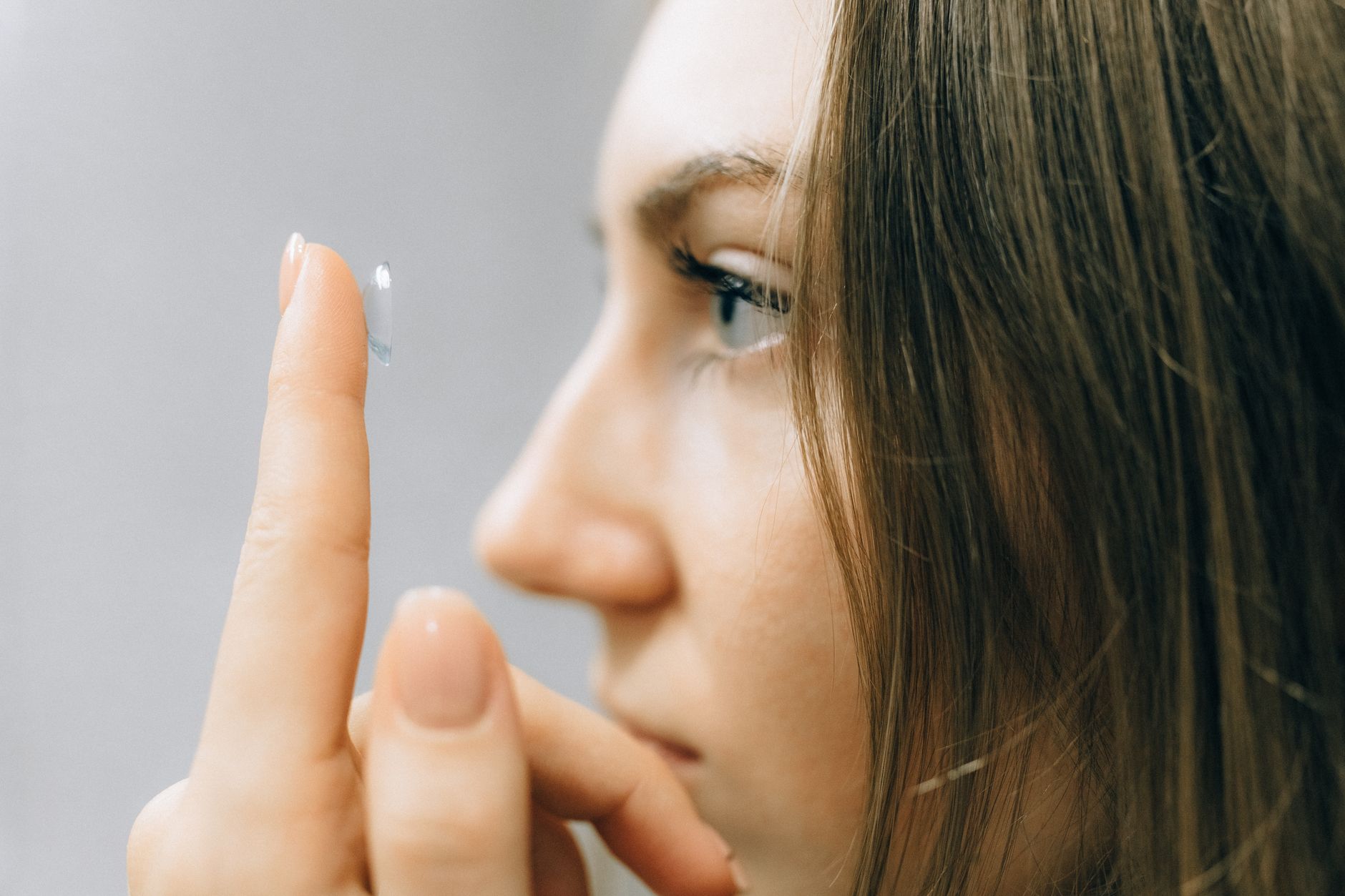
Always wash and thoroughly dry your hands before touching lenses. Inspect each lens before insertion: check for tears, debris, or inside-out orientation (a correctly oriented lens forms a smooth bowl shape, not a flared rim). Rinse lenses with contact lens solution, never tap water. Tap water carries Acanthamoeba, a microorganism that can cause a serious corneal infection. Start with the same eye every time to avoid mixing lenses. Look upward and pull down your lower lid to insert, look downward and gently pinch to remove. Limit daily wear to the hours your lens manufacturer specifies, typically 8-12 hours for daily cosmetic wear lenses. Remove before sleeping. Build wear time gradually on your first few days: 4 hours on day one, adding roughly 2 hours each subsequent day. This gradual approach lets your eyes adapt without stress.
What to Expect During Your First Wear
Mild awareness of the lens in the first 15-30 minutes is completely normal. This usually fades. Blinking frequency increases naturally at first as your eyes adjust. Lubricating eye drops compatible with contact lenses ease initial dryness. Redness that persists beyond 30 minutes or any pain is a signal to remove the lenses immediately and consult your eye care professional. Do not push through discomfort. Real comfort and real safety are not mutually exclusive. Well-fitted, high-quality lenses from reputable brands should feel unobtrusive within a short adjustment window.
How to Spot High-Quality Lenses vs. Cheap or Counterfeit Ones
The cosmetic contact lens market has a significant counterfeit problem. Research found that 60% of suspected counterfeit lenses tested were contaminated (aoa.org). That is not a number to gloss over. High-quality lenses sandwich the color print between two layers of lens material, keeping pigment away from direct contact with your cornea. Low-quality or counterfeit lenses print color on the lens surface, creating direct pigment-to-cornea contact and increasing toxicity risk substantially. FDA-cleared lenses carry a device registration number verifiable in the FDA's 510(k) database. Any legitimate US retailer will require a valid prescription before completing a purchase. The global coloured contact lens market reached $4.2 billion in 2025 (thebusinessresearchcompany.com), which has unfortunately made it an attractive target for counterfeiters.
Certifications and Safety Markers to Look For
FDA clearance via the 510(k) or PMA pathway is the baseline US safety standard for contact lenses. ISO 11540 and ISO 18369 are the international standards governing contact lens material biocompatibility and optical properties. CE marking indicates compliance with European Medical Device Regulation. Reputable brands publish their oxygen transmissibility (Dk/t) values; higher values mean more breathable lenses and healthier extended wear. Packaging on legitimate products includes lot number, expiration date, base curve, diameter, and manufacturer contact information. Missing any of these elements is a red flag. The following table summarizes how to compare high-quality lenses against counterfeit or low-quality alternatives.
Building a Lens Rotation: Matching Colors to Outfits, Moods, and Occasions
Beauty-forward consumers increasingly treat colored contacts like makeup: rotating colors by outfit, aesthetic, or content theme. A starter rotation of three to four colors covers most everyday and special occasion needs without overwhelming your budget or your eyes. For dark-eyed wearers, a practical starter rotation looks like this: a warm hazel for everyday wear, a soft sage green for creative or outdoor looks, a grey-green hybrid for going-out nights, and a bold color like a deep violet or icy grey for content shoots or events. Each lens shifts the perceived energy of your entire face. Warm colors feel approachable and lifestyle-editorial. Cool greys and blues read as high-fashion and intentional. Coordinating lens color with clothing and makeup undertones follows the same logic as matching jewelry metals to skin tone. The approach is intuitive once you start thinking about it through that lens, pun intended.
How to Coordinate Colored Contacts with Makeup
The eye look should either complement or intentionally contrast the lens color. It should never compete. For natural lens colors like hazel or honey brown, neutral and warm smoky eye makeup enhances the look without overwhelming the lens. For bold lens colors like grey, blue, or violet, minimal eye makeup lets the lens serve as the statement piece. Eyeliner shade matters more than most people realize: brown liner softens the lens edge and reads as more natural, while black liner creates contrast and amplifies drama. Lash choices interact with the lens look too. Natural lashes maintain the subtle-shift aesthetic. Dramatic lashes amplify the transformation effect and work best when paired with bolder lens colors. Building cohesion between your lens, liner, lash, and shadow is what elevates a colored contact look from interesting to genuinely striking.
Frequently Asked Questions
Do I need a prescription to buy colored contacts in the US even if I have perfect vision?
How long can I safely wear colored contacts in a single day?
Can colored contacts damage dark eyes over time?
What is the most natural-looking colored contact lens color for dark brown eyes?
Are there colored contacts specifically designed for black eyes, not just brown?
How do I know if a colored contact lens is sitting correctly on my eye?
Can I sleep in colored contacts?
What is the difference between daily, monthly, and yearly colored contact lenses?
Why do some colored contacts look fake and others look real?
How soon can I get colored contacts if I need them for an event this weekend?
What are the best brands for natural-looking colored contacts for dark eyes?
How do layered pigments in colored contacts enhance the natural eye color?
Are there specific shades that work best for creating a subtle shift in dark eyes?
What are the benefits of translucent color blending in colored contacts?
How do limbal rings affect the natural appearance of colored contacts?
Sources & References
- Eye Color Percentage by Country 2026 - World Population Review[industry]
- FDA - Contact Lenses[gov]
- Scientists find what on illegal contact lenses? | AOA[org]
- Beauty Contact Lens Market Outlook 2026-2034 - Intel Market Research[industry]
- The Science of Brown Eyes: Genetics, Health, and Global Prevalence - Debby Burk Optical[industry]
- Coloured Contact Lenses Market Growth Analysis Report 2026 - The Business Research Company[industry]
- Best Colored Contacts for Dark Eyes in 2026: Ultimate Guide - Contact Lens Marketplace[industry]
About the Author
Hapa Kristin Same-day Colored Contacts
Hapa Kristin offers same-day colored contacts designed for every skin tone and style. Their curated collection lets beauty-conscious women change their eye color as easily as their makeup.
Learn more at hapakristin.us →Related Posts

8 Best Colored Contacts for Warm Skin Tones (Ranked by a Beauty Brand)
Warm skin tones glow with honey, hazel, amber, and earthy green lenses — but the wrong color can wash you out instantly. This ranked list breaks down the eight best colored contact options for golden, olive, and bronze complexions, with same-day picks from Hapa Kristin so you can shop and wear today.
Everything You Need to Know About Colored Contact Safety, Comfort, and Care in 2026
Colored contacts can transform your entire look in seconds, but wearing them safely requires knowing the rules, the risks, and the right care routine. This guide covers everything from FDA regulations and prescription requirements to choosing a flattering color for your skin tone and keeping your lenses comfortable all day.

Colored Contact Shades for Brown Eyes: How to Find a Natural Match
Brown eyes are the most common eye color in the world, which makes finding colored contacts that actually transform them a real challenge. This guide breaks down 12 shades proven to show up beautifully over dark irises, matched by skin tone and aesthetic, so you never waste money on a color that disappears on your eyes.