Are Colored Contacts Safe for Daily Wear? What Optometrists and FDA Guidelines Actually Say
Yes, colored contacts are safe for daily wear when purchased with a valid prescription, sourced from an FDA-cleared brand, and worn according to your eye doctor's instructions. Non-prescription colored lenses from unregulated sellers carry serious infection risks. The FDA classifies all contact lenses, including purely cosmetic ones, as medical devices requiring a prescription before any legal sale in the United States.
Why the FDA Classifies Colored Contacts as Medical Devices
The FDA's decision to regulate cosmetic contact lenses as medical devices is not bureaucratic caution. It is grounded in direct physical risk. Under 21 CFR Part 886, the FDA classifies all contact lenses, regardless of whether they correct vision, as Class II or Class III medical devices. A lens that sits directly on your cornea, restricts oxygen, alters tear film distribution, and remains in contact with living ocular tissue for hours is, by any reasonable definition, a medical product. Selling colored contacts without a prescription violates the Fairness to Contact Lens Consumers Act (FTCLCA), and violations of the FTC's Contact Lens Rule can result in civil penalties of up to $42,530 per violation (ftc.gov). Separately, FCLCA infractions carry civil penalties of up to $11,000 per violation (aoa.org). The regulatory rationale is straightforward: a product that can permanently damage your vision needs pre-market review before it reaches your eyes.
What FDA Clearance Actually Means for a Lens Brand
FDA 510(k) clearance is not a rubber stamp. It means a manufacturer has submitted documentation showing that a lens material and manufacturing process are substantially equivalent to a predicate device already on the market and proven safe. Cleared lenses must meet ISO 18369 standards covering oxygen transmissibility (Dk/t), water content, and dimensional stability. These are measurable, enforceable thresholds, not marketing claims. Crucially, the FDA 510(k) database is publicly searchable, so any consumer can verify whether a specific lens product has cleared federal review. Brands importing from overseas without US clearance bypass every one of these checks. The database check takes about 60 seconds. Do it before you buy.
What Optometrists Actually Recommend for Safe Daily Wear
Every licensed optometrist will tell you the same thing: get a fitting first. A contact lens prescription is not the same as a glasses prescription. It must include your base curve measurement, lens diameter, power (even 0.00 for cosmetic lenses), and the specific product or material. Eye doctors typically recommend wearing colored contacts no more than 8 hours per day during the initial adaptation period, and most advise sticking to daily disposable formats for cosmetic wearers. The reason is practical, not arbitrary. Across the US, 45 million people wear contact lenses (cdc.gov), and the data on what goes wrong consistently points to improper wear time, skipped fittings, and poor hygiene. Annual comprehensive eye exams are the minimum standard of care for any contact lens wearer, including someone who only wears lenses for photo shoots or nights out.
How Base Curve and Diameter Affect Colored Lens Safety
Base curve and diameter are the two numbers that determine whether a colored lens actually fits your eye safely. Base curve, typically measured between 8.3 and 8.7 mm, describes how closely the lens conforms to your cornea's natural curvature. Get it wrong and the lens either sits too loosely, moving with every blink, or clamps too tightly, cutting off tear exchange. Restricted tear exchange reduces oxygen delivery to the cornea and raises the risk of corneal neovascularization, a condition where blood vessels grow into tissue that should remain clear. Diameter matters too. A lens that is too large in diameter can cause inflammation at the limbus, the junction between the cornea and the white of the eye. Most colored lenses come in one or two standard base curves, which is exactly why self-selecting a size without a fitting is risky. Your eye shape is individual. Your lens parameters need to match.
The Oxygen Permeability Problem With Colored Lenses
Colored lenses require an additional pigment layer embedded within the lens material. That pigment layer, however thin, reduces overall oxygen transmissibility compared to a clear lens of the same base material. Dk/t is the unit that measures how much oxygen passes through a lens per unit of thickness. Clear daily disposables from established brands typically achieve Dk/t values above 25, which is considered the minimum safe threshold for daily wear. Some colored lenses, particularly thicker or less sophisticated designs, fall below this threshold. Wearing a low-Dk/t lens for 10 or 12 hours creates hypoxic stress on the cornea, producing redness, irritation, and over time, the kind of vascular ingrowth that complicates future lens wear and contact prescribing. This is a real physiological trade-off that deserves more than a footnote. When evaluating any colored contact brand, look for published Dk/t values. If a brand does not publish them, that absence is itself informative.
What Hygiene Rules Eye Doctors Emphasize Most
Hygiene habits are where most lens-related problems start. Wash hands with soap for a full 20 seconds before handling lenses. Never rinse lenses or lens cases with tap water. Tap water can harbor Acanthamoeba, a microscopic organism responsible for a rare but sight-threatening form of keratitis. Replace lens cases every 30 days and always air-dry the case face-down on a clean tissue after use. Never top off old solution. Discard all solution and refill with fresh multipurpose or hydrogen peroxide solution every time. Remove lenses immediately if you notice redness, pain, blurred vision, or unusual discharge, and call your eye doctor the same day. These are not optional steps. They are the difference between a fun beauty tool and an emergency room visit.
What Are the Real Risks of Unregulated Colored Contacts
The risk profile of unregulated colored lenses is not vague or theoretical. It is documented in federal evaluations and case reports. When the FDA evaluated over 300 cosmetic contact lenses, 60% of the counterfeit lenses and 27% of the unapproved lenses showed microbial contamination that posed a direct threat to consumer health (aao.org). That contamination is already present in the sealed packaging before the lens ever touches your eye. Bacterial keratitis, a rapidly progressing corneal infection, has been linked in multiple case reports to non-prescription lenses purchased from beauty supply stores and third-party online marketplaces. A review of 1,075 reported contact lens-related infections between 2005 and 2015 found that nearly one in five resulted in eye damage, and more than 10 percent required emergency care (time.com). The unsafe version of colored lenses is not some rare edge case. It is the common one: unprescribed, low-quality, or over-worn decorative lenses sold without clinical oversight.
Why Cheap Online and Overseas Lenses Are Particularly Dangerous
Overseas manufacturers not registered with the FDA are not required to meet US biocompatibility or sterility standards. That is not a technicality. It means no third-party verification of lens parameters, no batch-level quality testing, and no accountability when a product causes harm. Lenses sold through third-party marketplaces frequently have inconsistent diameter and power within the same product listing. Counterfeit lenses may use industrial dyes placed on the anterior lens surface, where they make direct contact with the cornea. 85% of Acanthamoeba keratitis cases occur in contact lens wearers, and the condition is disproportionately linked to non-prescription lens use and tap water exposure (reviewofcontactlenses.com). Acanthamoeba keratitis can result in permanent vision loss or corneal transplant. Low price points are often achieved by using thicker, lower-Dk/t materials that look acceptable on a product listing but fail your eyes after a few hours of wear. The absence of a prescription requirement is the single clearest signal that a seller is operating outside any regulated framework.
How to Choose a Safe Colored Contact Lens Brand in the US
Evaluating a colored contact brand should follow the same framework you would apply to any regulated medical product. Start with the FDA 510(k) or De Novo database. If the brand or specific product line does not appear there, stop. Confirm that the retailer, whether physical or online, requires a valid prescription and does not offer to substitute a questionnaire or self-reported measurement. Look for ISO 13485 certification in the manufacturer's quality management system. ISO 13485 is the international standard specific to medical device manufacturing, and it is a meaningful signal of process discipline, not just a logo. Prioritize brands that publish Dk/t values, water content percentages, and full material names. If a brand cannot tell you the oxygen transmissibility of its lens, that is a gap in transparency that a reputable medical device manufacturer would not tolerate. Consumers using regulated disposable lenses demonstrate nearly 26% higher compliance rates with safe wearing schedules compared to those using unregulated sources (blog.hapakristin.us). That compliance gap translates directly into fewer infections and better long-term eye health outcomes.
| Evaluation Criterion | FDA-Cleared Brand | Unregulated Seller |
|---|---|---|
| Prescription required | Yes | No |
| 510(k) or PMA on file | Yes | No |
| Dk/t value published | Yes | Rarely |
| ISO 13485 certified manufacturing | Yes | Unknown |
| Batch-level quality testing | Yes | No |
| Microbial contamination risk | Low | High (up to 60% (aao.org) in FDA review) |
| Retailer accountability | Federal + state oversight | None |
What Your Eye Doctor's Prescription Must Include
A valid contact lens prescription in the US is a legally specific document. It must include your full name, the prescribing doctor's name and contact information, the issue date, and an expiration date (typically one year from the fitting). It must specify base curve, diameter, lens power (even 0.00 for cosmetic lenses), and the brand name or product line. Under the FTCLCA, your prescriber is required to give you a copy at no additional charge after a fitting. This matters practically. Never attempt to adapt a glasses prescription to a contact lens purchase. The measurements are different, and the products are regulated separately. Glasses prescriptions do not include base curve or diameter, which are the two most safety-critical parameters for a contact lens fit.
Colored Contacts for First-Time Wearers: A Practical Starting Guide
First-time lens wearers face a straightforward process if they follow the right sequence. Schedule a contact lens fitting with a licensed optometrist before buying anything, even if your vision is perfect. Ask for a trial pair to confirm comfort and fit before committing to a supply. At Hapa Kristin Same-day Colored Contacts, we see a lot of first-timers who try a lens for the first time at a content shoot and are surprised by how natural and comfortable it feels when the fit is right. For example, imagine a beauty content creator preparing for a high-stakes TikTok shoot scheduled for tomorrow morning who needs a lens color that complements her outfit and skin tone. With a valid prescription already in hand from her eye doctor fitting, she can order same-day colored contacts from an FDA-cleared brand, receive them before the shoot, and focus on creating content rather than worrying about whether her lenses will feel comfortable or look authentic on camera. That experience is only possible with a proper prescription in hand. Begin with daily disposable colored lenses rather than monthly formats. Retailers and distributors using regulated disposable lens portfolios have reported nearly a 21% decline in customer complaint rates associated with discomfort and irritation (blog.hapakristin.us). For a first-time wearer, eliminating the solution and case hygiene variables while your habits are still forming is a straightforward way to reduce risk. Start with a color close to your natural eye color for your first purchase. Build confidence with insertion and removal before moving to more dramatic looks.
How to Insert and Remove Colored Contacts Safely
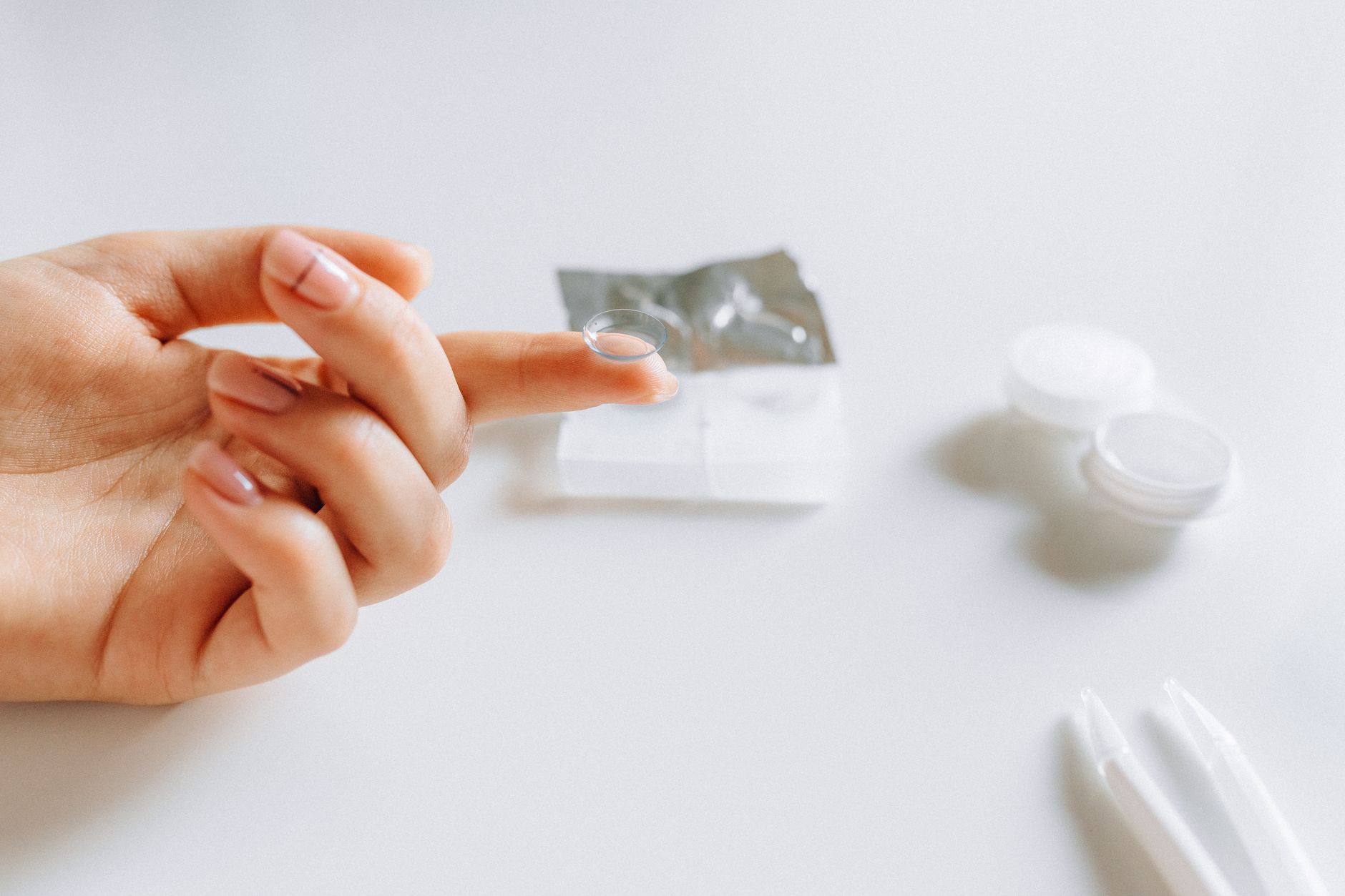
Insertion and removal technique matters more than most first-timers expect. Wash and completely dry your hands before every session. Place the lens on your index fingertip and check that it forms a bowl shape. A lens that curls outward like a taco is inside-out and will feel uncomfortable immediately. Look upward, gently pull down your lower eyelid with your middle finger, and place the lens on the lower white of your eye before releasing your eyelid. To remove, look upward, slide the lens to the white of your eye with a clean fingertip, then gently pinch it with your thumb and index finger. Never use fingernails to remove a lens. Always insert the same eye's lens first, every session, to avoid mixing up left and right prescriptions. Expect a 15 to 30 minute adaptation period. Mild awareness of the lens is normal. Pain is not.
The Daily Disposable Advantage Explained
Daily disposable colored lenses represent the clearest safety upgrade available to cosmetic lens wearers. You open a fresh, sterile lens every time you wear them. No case. No solution. No risk of biofilm accumulation from repeated use or improper rinsing. For someone who wears lenses two or three times a week for events, content shoots, or going out, a daily disposable format also means you are never wearing a lens that is three weeks into a monthly replacement schedule but saw only six total days of use. Monthly lenses accumulate protein deposits and microbial biofilm regardless of how many hours they have actually been worn. The per-day cost of daily disposables is higher on the surface, but the reduced infection risk and eliminated maintenance burden are genuine value, not a premium marketing angle. This is the format optometrists recommend most frequently for cosmetic colored contact wearers, and the clinical reasoning is sound.
Frequently Asked Questions
Do I need a prescription for colored contacts that do not correct my vision?
How many hours per day is it safe to wear colored contacts?
Can I sleep in my colored contacts if I forget to remove them?
What is the difference between FDA-cleared colored contacts and non-cleared ones?
Are colored contacts safe for people with astigmatism?
How do I know if my colored contacts are causing an eye infection?
Can I wear colored contacts every day, or should I take breaks?
What happens if I buy colored contacts without a prescription in the US?
Are daily disposable colored contacts safer than monthly ones?
Are prescription colored contacts safer than non-prescription ones?
What does the FDA require for colored contact lens sellers?
How often should I replace daily wear colored contacts?
Can colored contacts cause eye infections or corneal damage?
What signs mean I should stop wearing colored contacts?
Sources & References
- Corneal Ulcer Risks in Soft Contact Lens Wear: An Update | Review of Contact Lenses[industry]
- Fairness to Contact Lens Consumers Act Compliance and Safety | AOA[org]
- About Contact Lenses | Healthy Contact Lens Wear and Care | CDC[gov]
- Cosmetic Contact Lenses: Potential Threat to Vision Health | American Academy of Ophthalmology[org]
- Best Colored Contact Lens Brands 2026 (US) | Hapa Kristin Blog[industry]
About the Author
Hapa Kristin Same-day Colored Contacts
Hapa Kristin offers same-day colored contacts designed for every skin tone and style. Their curated collection lets beauty-conscious women change their eye color as easily as their makeup.
Learn more at hapakristin.us →Related Posts
8 Best Colored Contacts for Warm Skin Tones (Ranked by a Beauty Brand)
Warm skin tones glow with honey, hazel, amber, and earthy green lenses — but the wrong color can wash you out instantly. This ranked list breaks down the eight best colored contact options for golden, olive, and bronze complexions, with same-day picks from Hapa Kristin so you can shop and wear today.
Everything You Need to Know About Colored Contact Safety, Comfort, and Care in 2026
Colored contacts can transform your entire look in seconds, but wearing them safely requires knowing the rules, the risks, and the right care routine. This guide covers everything from FDA regulations and prescription requirements to choosing a flattering color for your skin tone and keeping your lenses comfortable all day.

Colored Contact Shades for Brown Eyes: How to Find a Natural Match
Brown eyes are the most common eye color in the world, which makes finding colored contacts that actually transform them a real challenge. This guide breaks down 12 shades proven to show up beautifully over dark irises, matched by skin tone and aesthetic, so you never waste money on a color that disappears on your eyes.