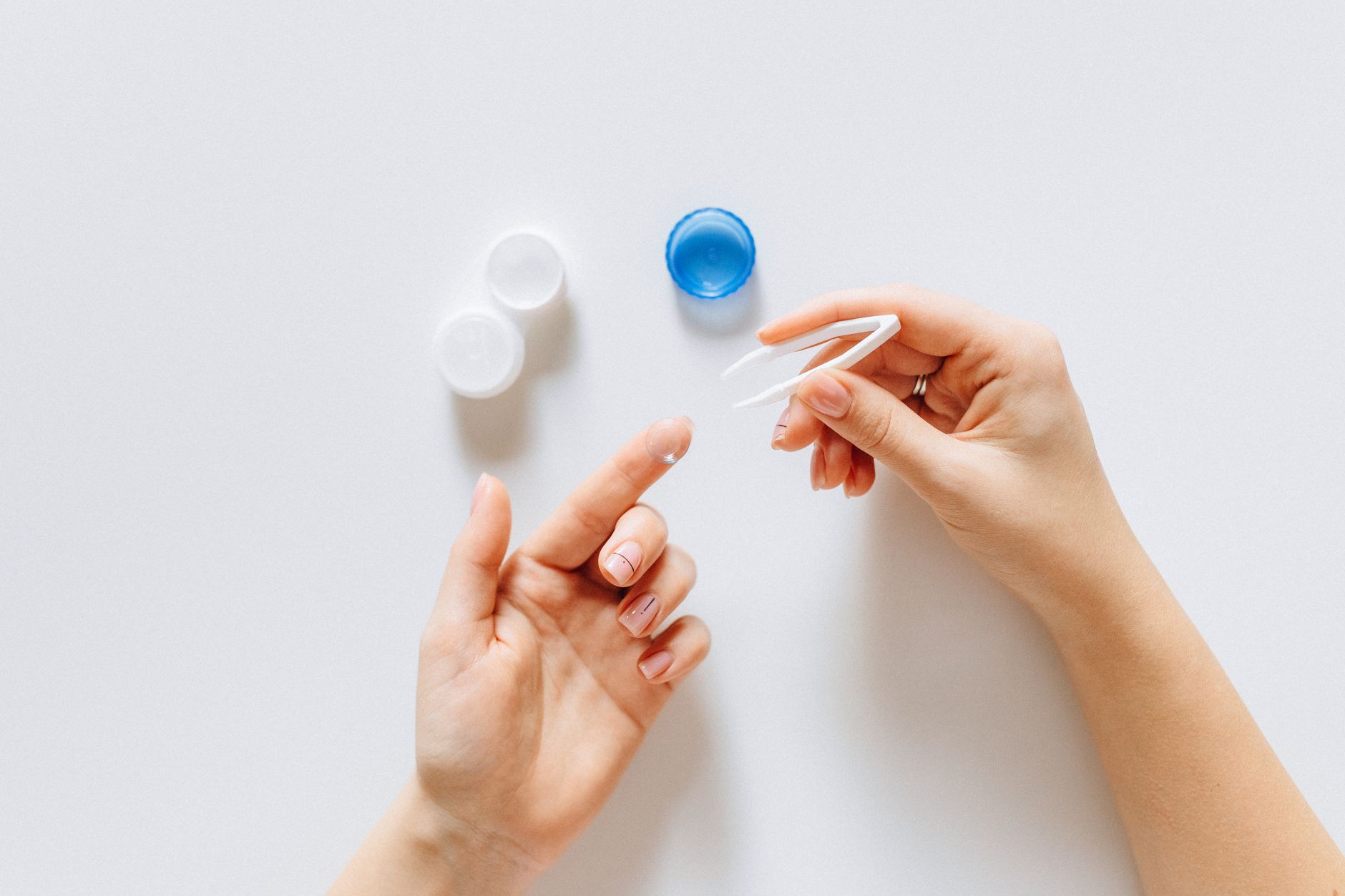
To care for monthly colored contacts, rinse them daily with fresh multipurpose or hydrogen peroxide solution, store them in a clean case with solution replaced every day, and never wear them beyond 30 days from first open. Follow these steps consistently and your lenses will stay comfortable, clear, and safe for the full month.
How Monthly Colored Contacts Actually Work
Monthly colored contacts are soft hydrogel or silicone hydrogel lenses engineered for up to 30 days of wear, calculated from the day you first crack open the blister pack, not the day you count 30 individual uses. That distinction matters more than most wearers realize. The pigment in colored lenses sits sandwiched between two layers of lens material, creating a physical structure that is slightly thicker and denser than a clear lens of equivalent power. That extra density is what gives you a vivid, defined iris effect, but it also means the lens accumulates protein and lipid deposits from your tears faster than a clear lens would. In our experience at Hapa Kristin Same-day Colored Contacts, understanding this deposit buildup is why we emphasize daily cleaning as non-negotiable for keeping colored lenses safe and comfortable throughout their 30-day lifespan. The global colored contact lens market reached $4.2 billion in 2025 and is projected to reach $4.66 billion in 2026 at a 10.9% CAGR (thebusinessresearchcompany.com), which tells you just how many people are adding these to their beauty routines right now. The FDA classifies all contact lenses, including purely cosmetic non-corrective pairs, as Class II or Class III medical devices requiring a valid prescription. This is not a formality. It exists because lenses sit directly on corneal tissue and can cause real harm when misused. Oxygen permeability, measured as a Dk/t value, tells you how much oxygen reaches your cornea through the lens. Lower Dk/t values mean less breathable lenses and greater risk of hypoxia-related complications with extended wear.
Why Colored Lenses Need More Attention Than Clear Lenses
The pigment layer in colored lenses does more than create a beautiful effect. It physically reduces the flow of oxygen to the cornea compared to an optically equivalent clear lens. Deposits from tears, including proteins like lysozyme and lipids from your meibomian glands, adhere to pigmented surfaces faster than to smooth clear lens material. This is not a design flaw. It is simply chemistry. Daily cleaning is not optional for colored lenses; it is the only thing standing between you and a lens that becomes a petri dish by week two. We recommend treating your daily cleaning routine with the same consistency you bring to skincare, because the deposits on colored lenses accumulate faster than on clear lenses, and skipping even one day accelerates bacterial growth. Some colored lenses also incorporate UV-blocking tints, and those tints degrade with continued exposure to cleaning chemicals and tear fluid. After 30 days, even a lens that "looks fine" has lost structural integrity at a molecular level. That is exactly why the replacement schedule printed by the manufacturer is a safety specification, not a suggestion.
Step-by-Step Daily Cleaning Routine for Monthly Colored Contacts
A consistent daily routine is the single most effective thing you can do to protect your eyes and extend the comfortable life of your lenses within their 30-day window. Studies have consistently demonstrated that up to 99% of contact lens wearers do not follow the necessary directions to keep their lenses pathogen-free (jpmsonline.com). That number is striking. It means nearly every wearer is cutting a corner somewhere. Start by washing your hands thoroughly with soap and drying them with a lint-free towel. Then place each lens in the palm of your hand, add a few drops of multipurpose solution, and rub gently in a circular motion for at least 20 seconds per side. Rinse each lens with fresh solution before placing it in your eye or returning it to the case. Remove lenses before swimming, showering, or sleeping unless your specific lens carries an FDA approval for extended wear (most cosmetic colored lenses do not).
Choosing the Right Solution for Colored Contact Lenses
The solution you choose has a measurable impact on lens longevity and eye health. At Hapa Kristin Same-day Colored Contacts, our team has found that customers who match their solution type to their specific lens material and eye sensitivity experience dramatically fewer complaints about discomfort or deposit buildup. Two main categories exist, and understanding the trade-offs helps you make a smarter call. Multipurpose solutions (MPS) are convenient, all-in-one products that clean, rinse, disinfect, and store in one bottle. Even bottles labeled "no-rub" perform significantly better when you actually rub the lens during cleaning; the physical action removes far more deposits than soaking alone. Hydrogen peroxide systems, such as Clear Care, provide a deeper biochemical clean and are the preferred choice for anyone with sensitive eyes or a tendency toward protein buildup on lenses. The critical trade-off: hydrogen peroxide solutions require a full 6-hour neutralization cycle using their specialized case before the lens can touch your eye. Skipping that step and inserting the lens early causes an immediate, painful chemical burn to the cornea. No shortcuts. Always verify that your chosen solution is compatible with the specific lens material listed in your prescription, because some silicone hydrogel materials react differently with certain preservative systems in multipurpose solutions.
| Feature | Multipurpose Solution | Hydrogen Peroxide System |
|---|---|---|
| Ease of use | High | Moderate |
| Neutralization time required | None | Minimum 6 hours |
| Deposit removal efficacy | Good | Excellent |
| Best for sensitive eyes | Sometimes | Yes |
| Risk if steps are skipped | Low | High (corneal burn) |
| Compatible with colored lenses | Yes | Yes (check lens material) |
How Long You Can Safely Wear Monthly Contacts Per Day
Most eye care professionals recommend a maximum of 8 to 12 hours of daily wear for cosmetic colored lenses. New wearers should start with 2 to 4 hours on the first day and increase gradually over the first week, giving your cornea time to adapt to reduced oxygen flow. Remove lenses immediately if you notice redness, blurred vision, or any sensation of irritation that does not feel normal. These are not minor inconveniences. They are your cornea signaling stress. Noncompliance with overnight wear was observed in 24% of subjects in one compliance study (reviewofoptometry.com), confirming that sleeping in lenses is one of the most common and most dangerous compliance failures wearers make.
Proper Storage Habits That Protect Your Lenses Between Wears
Storage hygiene is where most lens-related infections begin. The rule here is simple but non-negotiable: never reuse yesterday's solution. Discard every drop from the case before adding fresh solution, every single day, even on days when you did not wear your lenses. Topping off old solution, meaning adding fresh solution on top of used solution rather than replacing it entirely, dilutes the active disinfecting agents and leaves dangerous bacteria alive in the case. This is not a theoretical risk. Biofilm, a protective matrix that bacteria construct to resist disinfectants, can form on the interior walls of a lens case within days of inadequate cleaning. A contaminated storage case is one of the most direct routes to microbial keratitis, a corneal infection that can cause permanent vision damage if untreated. After emptying the case, rinse it with fresh solution (never tap water), then place it face-down on a clean tissue and let it air-dry completely. Replace the case itself at least once every 30 days. A 2019 compliance study found that 74.6% of contact lens case users were unsure when they should replace their case (reviewofoptometry.com). That number explains a lot of preventable infections.
What Happens When You Store Lenses in Old or Diluted Solution
The chemistry of contact lens disinfection depends on the active agents in your solution maintaining a minimum effective concentration. The moment you top off old solution with fresh, that concentration drops below the threshold needed to kill Acanthamoeba, Pseudomonas, and other pathogens that thrive in lens cases. Acanthamoeba keratitis, caused by a microscopic organism found in tap water and improperly maintained lens cases, is particularly dangerous because it is resistant to many standard treatments and can cause severe, permanent vision loss. This is why "never use tap water" is such an absolute rule: it is not about mineral content or taste. Tap water is a reservoir for Acanthamoeba. Store lenses at room temperature away from direct sunlight and heat, both of which accelerate degradation of the lens polymer. Label each compartment clearly with L and R to avoid switching lenses between eyes, which can cause blurred vision and discomfort if your prescription differs between eyes.
Warning Signs That Tell You to Replace Your Lenses Now
Knowing when to toss a pair is just as important as knowing how to clean one. The 30-day replacement schedule is not about aesthetics. Lens material breaks down at the molecular level after 30 days of exposure to tears, oxygen, and cleaning chemicals. The polymer matrix becomes less flexible, the surface becomes rougher, and deposits become impossible to remove through standard cleaning. Research found that noncompliance with replacement schedules was 38.7% among contact lens wearers studied (reviewofoptometry.com). Nearly 4 in 10 wearers are stretching lenses past their replacement date. Replace your lenses immediately if you notice any of the following: persistent redness or irritation that does not resolve within 10 to 15 minutes of lens removal; blurred or hazy vision that does not improve with blinking; visible tears, nicks, or warping in the lens shape; discomfort from the first moment of insertion despite a correct cleaning routine; any change in color vibrancy or lens transparency; or any lens that has been exposed to non-sterile water including pool water, shower water, or a bathroom sink.
Why the 30-Day Rule Is Not Negotiable
Here is the part that surprises most wearers. Even a lens you opened and wore only once still needs to be discarded 30 days after that first opening. The clock starts at first use, not at 30 cumulative hours of wear. Once the seal is broken, the lens begins interacting with atmospheric oxygen, your tear chemistry, and repeated cycles of cleaning agents, all of which accelerate material aging. Lenses stored in their original sealed blister pack carry a printed expiration date on the package, but once opened, that date becomes irrelevant. Thirty days is your new deadline. Overwearing monthly lenses is consistently cited by optometrists as the most common cause of preventable contact lens infections. Consumers using regulated disposable lenses demonstrate nearly 26% higher compliance rates with safe wearing schedules compared to those using less regulated alternatives (strategicmarketresearch.com). The data is clear. Compliance protects you.
Building a Lens Rotation Like a Beauty Routine with Hapa Kristin
At Hapa Kristin Same-day Colored Contacts, we think about lens care the same way our customers think about skincare: consistency makes it effortless. The most effective lens care habit is the one that fits into a routine you already have. Treat your lens collection the way you treat a lipstick rotation or a lash collection. Organize pairs by mood, outfit, or content theme. Write the opening date directly on the blister pack or lens case in permanent marker the moment you crack it open. No guessing, no approximating. Because approximately 58% of cosmetic contact lens purchases among consumers aged 18-34 now happen through digital commerce channels (strategicmarketresearch.com), restocking a beloved color on the same day a pair hits its 30-day limit is genuinely feasible. Same-day availability means spontaneity does not have to mean compromise.
Consider a concrete scenario: you are a content creator shooting a K-beauty themed look on a Friday evening. You have a pair of gray lenses that are on day 28. Rather than stretching them two extra days and risking irritation mid-shoot, you swap them for a fresh pair you already have stocked. The fresh lenses feel crisp, your eyes look vibrant on camera, and you have not gambled with your corneal health for a reel. Keep a compact lens care kit in your beauty bag: a travel bottle of solution, a spare case, and lubricating eye drops safe for contact lens wearers. US law requires a valid prescription to purchase any colored contacts, including non-corrective cosmetic pairs. Hapa Kristin can point you toward resources for getting an updated prescription so your rotation stays legal and safe.
How to Choose Hapa Kristin Colors That Work With Your Skin Tone
Color selection does not have to be trial and error. Warm skin tones with yellow, peach, or golden undertones tend to look most natural and striking in honey, hazel, and chestnut shades that echo the amber warmth already present in your complexion. Cool or neutral skin tones, those with pink, beige, or olive undertones, are beautifully complemented by gray, violet, and blue-green lenses that create high contrast against the skin. The Hapa Kristin shade range is built around personal color science rather than trend cycles alone, which means first-time wearers get a framework for decision-making rather than a wall of ambiguous swatches. Natural-looking colored contacts for dark eyes use limbal rings and layered pigment patterns that blend with deep brown irises instead of sitting on top of them, which is the difference between a "wow" result and an obviously artificial one. Choosing thoughtfully means your lenses become a seamless part of your look, not a distraction from it.
Frequently Asked Questions
Can I sleep in my monthly colored contacts if I only wore them for a few hours?
How do I know if my monthly colored contacts have protein buildup?
Is it safe to use the same lens solution for both colored and clear contacts?
What should I do if I accidentally drop a colored contact lens on the floor?
Can I wear monthly colored contacts every single day for the full 30 days?
Do I need a prescription to buy colored contacts from Hapa Kristin even if I have perfect vision?
How do I safely remove a colored contact lens that feels stuck to my eye?
Can I switch between two different colored contact pairs in the same month?
How do I clean monthly colored contacts safely?
What solution is best for colored contact lenses?
How long can monthly colored contacts be worn?
How should I store contacts overnight?
When should I replace monthly colored contacts?
Sources & References
- Cosmetic Contact Lenses Market Report (2026) (opens in a new tab)[industry]
- Study Ranks Contact Lens Compliance - Review of Optometry (opens in a new tab)[industry]
- Coloured Contact Lenses Market Size Report 2026-2030 (opens in a new tab)[industry]
- Factors Associated with Discontinuation of Contact Lens Use and Measures to Improve Adherence - Journal of Pioneering Medical Sciences (opens in a new tab)[org]
About the Author
Hapa Kristin Same-day Colored Contacts
Hapa Kristin offers same-day colored contacts designed for every skin tone and style. Their curated collection lets beauty-conscious women change their eye color as easily as their makeup.
Learn more at hapakristin.us → (opens in a new tab)Related Posts

8 Best Colored Contacts for Warm Skin Tones (Ranked by a Beauty Brand)
Warm skin tones glow with honey, hazel, amber, and earthy green lenses — but the wrong color can wash you out instantly. This ranked list breaks down the eight best colored contact options for golden, olive, and bronze complexions, with same-day picks from Hapa Kristin so you can shop and wear today.
15 min read
Everything You Need to Know About Colored Contact Safety, Comfort, and Care in 2026
Colored contacts can transform your entire look in seconds, but wearing them safely requires knowing the rules, the risks, and the right care routine. This guide covers everything from FDA regulations and prescription requirements to choosing a flattering color for your skin tone and keeping your lenses comfortable all day.
16 min read
Colored Contact Shades for Brown Eyes: How to Find a Natural Match
Brown eyes are the most common eye color in the world, which makes finding colored contacts that actually transform them a real challenge. This guide breaks down 12 shades proven to show up beautifully over dark irises, matched by skin tone and aesthetic, so you never waste money on a color that disappears on your eyes.
11 min read